
How nmg grew Atlys organic traffic 393% in 9 months
Visa-tech category creator. Andreessen Horowitz-funded. 18 source-country corridors. The full SEO playbook that scaled atlys.com from 44,666 to 220,194 monthly organic visits — and kept compounding for three years after the engagement ended.






What's in this case study
- TL;DR — at a glance
- About Atlys
- Atlys company evolution
- The challenge
- Our strategy: the 6-Pillar Framework
- The work — 9-month timeline
- Results — 4 layers of evidence
- Multi-market growth: US vs India
- Deep dive: Low-Hanging Fruit
- Deep dive: Master Keyword Research
- Deep dive: Source-Magnet Digital PR
- Lessons learned (the honest version)
- AI search era addendum (2026)
- Frequently asked questions
- Client perspective
- Could we do this for you?
- About NMG Digital
01.TL;DR
The whole story in 30 seconds
In July 2022, Atlys was a fast-growing visa-tech startup hitting an SEO ceiling: 35,000 monthly organic visits, 1,500+ duplicate-canonical pages flagged in Search Console, no master keyword research, and a single back-end developer as the chronic execution bottleneck. Over a 9-month engagement (1 Jul 2022 – 10 Apr 2023), NMG Digital ran a 6-pillar visa-vertical playbook — master keyword research across 18 source-country markets, a low-hanging-fruit content sprint that lifted targeted-page traffic 165% in seven days, programmatic locale-aware page templates, a paid + outreach link-building dual-track, and a curated-report digital-PR methodology. By April 2023, atlys.com was at 220,194 monthly organic visits (+393%), 3,914 keywords ranking in positions 1-3 (4.63× / +363%), and Domain Rating 51 (up from 37). Three years after the engagement closed, the SEO foundation we built was still compounding: 290k+ monthly organic visits, DR 65, 4,073 referring domains.
| Metric | Engagement start (Jul 2022) | Engagement end (Apr 2023) | Change |
|---|---|---|---|
| Monthly organic visits (Ahrefs) | 44,666 | 220,194 | +393% |
| Organic keywords ranking (top 100) | 57,244 | 116,287 | +103.1% |
| Top-3 position keywords | 846 | 3,914 | +362.6% |
| Domain Rating | 37 | 51 | +14 pts |
| Referring domains | 408 | 873 | +114.0% |
| Organic traffic value | $28,756 / mo | $70,599 / mo | +145.5% |
Source: Ahrefs site explorer for atlys.com (subdomains mode), pulled May 2026 covering Jul 2022 – Apr 2023.
Organic traffic — full visibility, before, during and after the NMG engagement
02.About Atlys
Atlys is the category-defining visa-tech company. Founded in 2021 by Mohak Nahta — a former Pinterest software engineer who had personally needed five different visas for a single work trip — Atlys built a mobile-first platform that handled application paperwork, document upload, government API submission, and status tracking for visas to dozens of destinations.
The founding insight was deceptively simple. Visa procedures differ across countries; the underlying documents don't. A platform that consolidated documentation once and surfaced it across destinations could compress a six-week, paperwork-heavy ordeal into a single mobile flow. Andreessen Horowitz (a16z) led the seed round in October 2021, with Pinterest co-founders Ben Silbermann and Evan Sharp, the Chainsmokers' Mantis VC, Long Journey Ventures, South Park Commons, and Ari Emanuel's Endeavor all participating. The thesis was the founder's lived experience as the edge.
By July 2022, when NMG's engagement began, the product had clear product-market fit: a polished iOS and Android app, a solid web experience, and ~35,000 monthly organic visits. The core ICP was the Indian middle-class traveller, with Dubai and Singapore corridors leading demand. What the company didn't have was an SEO foundation that could keep up with Mohak Nahta's growth ambitions. The founder's stated north-star: 50,000 organic clicks per day.
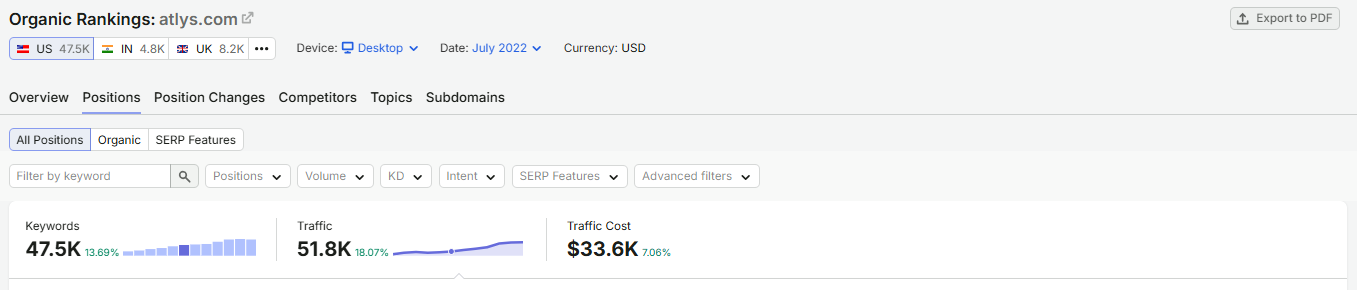
Engagement-start state. 47.5K keywords, 51.8K organic traffic, $33.6K traffic cost.
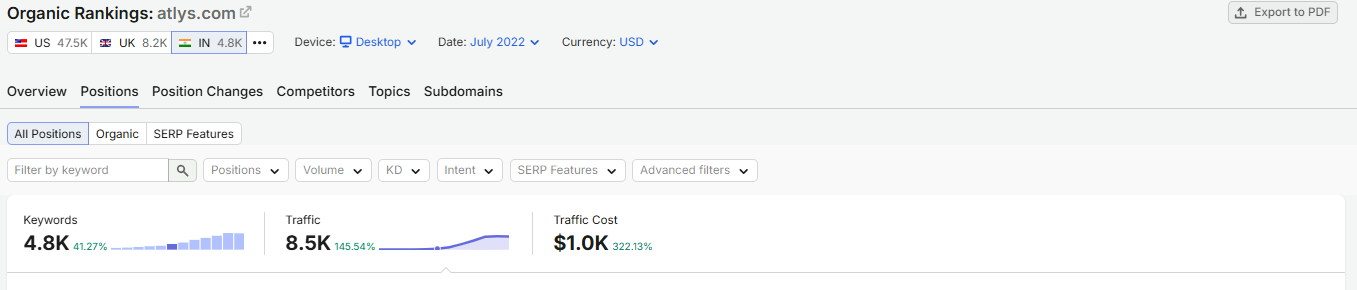
The core market at the starting line. Just 4.8K keywords and 8.5K organic traffic — the India engine had barely turned over.
Why this engagement was harder than average
Three structural challenges made Atlys's SEO problem unusually difficult:
- Google policy hostility. Visa services live under "government services" in Google's policy. Even on the organic side, Google's quality team scrutinises pages that imply government authority. Atlys had to write every page knowing reviewers would read it sceptically.
- The 18-country footprint problem. Atlys's audience was India-to-the-world. The 18+ destination markets each needed locale-specific content, and the source-country localisation (visa-for-Indians, visa-for-Britons, visa-for-South-Africans) doubled the surface area again.
- Single-developer execution capacity. Atlys ran lean on engineering. One back-end developer carried the full weight of CMS migrations, programmatic page templates, schema implementation, the airline-partnership integration, and bug-fixes — all simultaneously.
That last constraint shaped almost every tactical decision in the engagement. We could plan and brief work faster than the team could ship it, so picking the right work to brief became more important than the brief itself.
03.Atlys company evolution — the broader context
Why this matters: case studies are sharper when you can see the work in the context of the company's full trajectory. NMG's 9-month engagement sat between Atlys's seed round and Series A. The compounding evidence stretches from there to a $36 M Series C and a B2G spinoff. Here's the timeline.
Funding milestones
| Round | Date | Amount | Lead investors |
|---|---|---|---|
| Seed | Oct 2021 | $4.25 M | Andreessen Horowitz (a16z) · Pinterest co-founders Silbermann + Sharp · Chainsmokers' Mantis VC · Long Journey Ventures · South Park Commons · Endeavor |
| Series A | Sep 2023 | $12 M | Peak XV Partners (former Sequoia India) + Elevation Capital · with a16z, South Park Commons, Mantis VC |
| Series B | Sep 2024 | $20 M | Peak XV + Elevation Capital · with DST Global + Headline joining |
| Series C | Mar 2026 | $36 M | Susquehanna Asia Venture Capital · with Elevation, Long Journey, Peak XV, MakeMyTrip (new strategic) |
| Total raised | — | ~$73 M | Series A valuation: $44 M (Sep 2023) |
Sources: TechCrunch (Oct 2021), a16z, YourStory, Business Standard, Crunchbase, Tracxn.
Product & business milestones
- NMG's engagement ended in April 2023 — five months later, Atlys raised Series A. The SEO foundation we built was visible in due-diligence data rooms.
- Three years and three funding rounds after the engagement closed, atlys.com's organic-traffic engine continued operating at 250k–550k monthly visits. Foundation work that compounds independently is the hardest credibility point in any agency case study.
- The Skylane B2G launch in 2025 demonstrates that the consumer brand NMG helped scale gave Atlys the platform leverage to spawn a second product line.
04.The challenge
The engagement opened on 1 July 2022 with a contract signature, followed by the kickoff call on Tuesday 5 July. Within ninety minutes of that first call, three layers of problem had been catalogued.
Business challenge
Atlys was on an a16z-funded growth runway. The founder's stated north-star was 50,000 clicks per day. The roadmap to get there had to combine: (a) breaking through three priority markets — Dubai, Singapore, Thailand — within 90 days; (b) layering long-tail visa-corridor content for the remaining 15+ countries; and (c) getting the Atlys app downloaded and used, not just visited.
Around the engagement, Atlys was running ~$20-22k/month of marketing investment across SEO, content, design and dev. The opportunity cost of unfocused work was high, and the team's tolerance for slow-compounding strategies was limited.
Markets for India. Currently we're just going to focus on three business markets which Dubai, Singapore and I think it was Thailand. And we're gonna try and break through these markets in three months and however we get there, we just need to get there. — Richard, Atlys, Goal-setting call, 8 July 2022
Technical SEO situation
The Search Console audit, run live during the kickoff call, surfaced a long list of structural issues. The numbers as captured on day one:
- 116 page-errors in the Coverage report
- ~9,500 excluded pages — a big crawl-budget bleed
- 50 server-5xx errors on programmatic pages
- 404 errors on US-locale embassy pages — a programmatic API integration that had silently broken
- 1,500+ pages flagged "alternate page with proper canonical tag" — locale folders (`/en-IN/`, `/en-GB/`, `/en-US/`) all showing the same content under different URLs
- Tag pages (~17) leaking low-quality archive content
- Missing FAQ schema on most service pages, plus broken FAQPage entities where it was implemented
- Sitelink search box broken — the AJAX search had no static `?s=query` fallback page to resolve to
- 13 mobile usability errors
- Core Web Vitals: LCP and FID failing on mobile; CLS solid
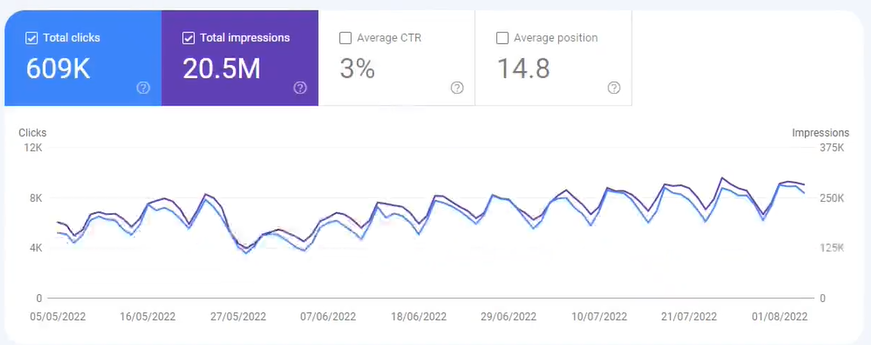
The most credible before-shot there is. 609K clicks, 20.5M impressions, 3% CTR and an average position of 14.8 — real traction, but stuck below the fold. Pulled from inside Atlys's own property, so every number that follows is anchored to first-party data.
Strategic gap
Beyond the technical inventory, three strategic gaps stood out: (1) no master keyword research for any of the 18 target markets — the content team was shipping pages by intuition; (2) no link-building infrastructure — neither paid placement, nor outreach, nor source-magnet PR existed in any organised form; (3) no programmatic content discipline — the embassy pages and locale folders had been launched without locale-aware content, leading to the duplicate-canonical mess. Atlys had ambition without architecture.
- Atlys had real traction (~35k organic visits/month) but had hit a ceiling driven by three structural constraints: chaotic technical SEO, no keyword discipline, no link infrastructure.
- NMG's job wasn't to fix any one thing — it was to identify the unlock that would compound across all three problems simultaneously.
05.Our strategy: the 6-Pillar Visa-Vertical Framework
After two days reviewing the Search Console data, the existing pages, the competitor set and the team's bandwidth realities, we converged on a six-pillar framework that has since become NMG's standard playbook for any visa-vertical or high-volume-localised SEO engagement.
Master keyword research
An 8-source pipeline (seed keywords → existing rankings → competitor keywords → content-gap analysis → keyword expansion → cleaning → grouping → sitemap mapping). Repeated for 18 source-country markets. Each country deck = 200+ rows of qualified keywords with intent tagging.
Low-Hanging Fruit content updates
Identify keywords ranking in positions 6-20, update on-page (title, H1, H2, FAQ schema, intro paragraph, internal links, alt tags) using the keyword. Submit to Google. Within 7-14 days, ~30-40% move into the top 5.
Tier 1 / 2 / 3 content layering
Mega-pillar (country master page) → sub-pages (visa types, requirements, embassy info, FAQs) → blog/tools (how-to, comparison, eligibility quiz). Internal linking concentrates authority on the money pages.
Programmatic page templates
Country × visa-type matrix and source-country localised pages. Generic frame paragraphs with bold-keyword-only swaps; FAQs are universal. Locale-aware data points (currency, embassy address, flag) prevent duplicate-canonical penalties.
Paid + outreach link building (dual-track)
Free DB (publishers willing to give free links) + Paid DB (publishers ready to publish for fee) + Publishing-in-queue + Content-received columns. Daily Slack ops. Anchor-text strategy locked around primary money keywords.
Source-magnet digital PR
Curated industry reports as backlink-magnet content. Outreach starts BEFORE publication — publishers tagged as contributors during research, motivated to amplify when the asset goes live. Three formats: niche survey, DIY industry report, curated report.
The framework's core insight: in a high-velocity content vertical, you don't get to pick "technical SEO" or "content" or "links." You ship all three on parallel tracks, with weekly cross-track updates, or none of them compounds. The visa vertical specifically punishes any agency that thinks it can sequence the work — Google's ranking algorithm, for visa queries, weighs technical authority, content quality, and link signals roughly equally.
Why this beat alternative strategies
Two strategies we considered and rejected:
Strategy A — go deep on one country first. The classic "dominate one niche, then expand" approach. Rejected because Atlys was an a16z-funded growth-stage company with an 18-country roadmap already promised to investors. A 12-week single-country deep-dive would have starved the broader pipeline. (Note: in retrospect, this was the right call for Atlys's stage. For a smaller visa startup, we'd do the opposite — start with one country.)
Strategy B — pure technical SEO sprint, then content. Fix the 116 errors, the 1,500 canonical issues, and the schema before any new content shipped. Rejected because Atlys's content-team capacity was an under-used asset; halting them would have wasted weeks. We instead ran technical fixes and content briefs in parallel.
06.The work — 9-month timeline
Six phases. Twenty weekly meetings (Tuesday standup, later moved to Friday for the digital-PR push). Forty-plus deliverables. The detailed cadence:
Onboarding, audits, infrastructure
Set up the operational stack on day one: a Google Drive "Atlas" folder (deliverable / reporting / working sub-folders), Trello with five lists (Reference & Login, SEO Month 1, Link Building, Discussion Items, Meeting MOMs), MS Teams for weekly calls, Slack for daily comms. Every Trello card update tagged the responsible person on both sides — that single discipline is what kept a 6-person cross-functional team coordinated through nine months.
Audits delivered: Search Console audit (live on the kickoff call), technical SEO analysis, website quality audit. Goals locked in the Phase-2 call: three target markets (Dubai, Singapore, Thailand) over three months.
Keyword research, low-hanging fruit, content briefs
The first big payoff arrived seventeen days in. The low-hanging-fruit content updates — published 13 July, indexed by 14-15 July — produced a +165% lift on the targeted page set in seven days. By 22 July, 38 new keywords were ranking on the target set, and the Dubai Visa page had picked up 46 fresh ranking keywords from a baseline of zero.
Three days later, the team caught a piece of keyword research that surprised even Atlys: the exact-match query "UAE visit visa" carried massive volume that the in-house content team had not been targeting. This single discovery rerouted the keyword pipeline for the next sixty days.
Apparently UAE visit visa like that exact query has a lot of volume. I didn't realize but apparently people do search like visit visas. — Richard, Atlys, on the keyword discovery, 29 July 2022
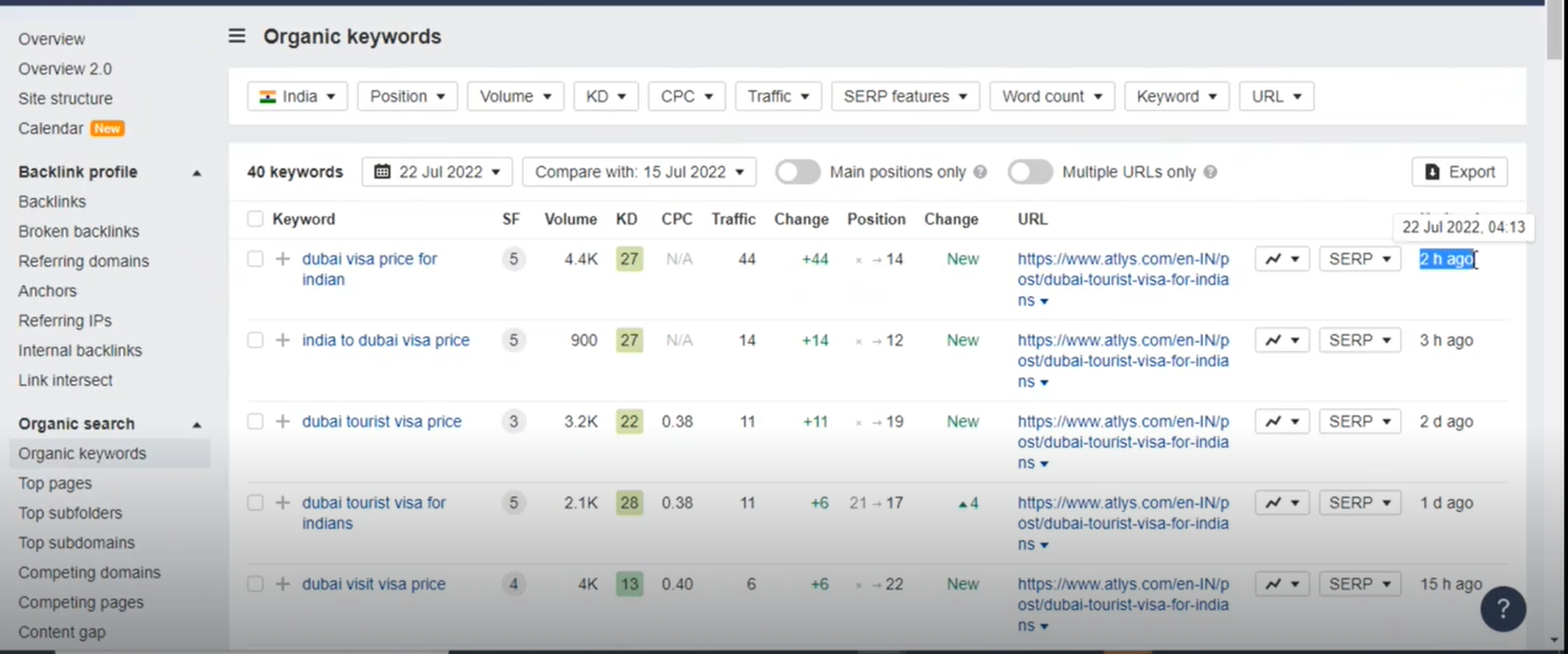
One page, one week, 40 fresh keywords. Eight days after the on-page refresh, the Dubai visa page picked up new India rankings across the board — “dubai visa price for indian” (4.4K volume) entered at #14 (+44 traffic), “dubai tourist visa for indians” jumped 21 → 17. This is the LHF play working in real time.
Link building campaign, schema rollout, programmatic content
The paid link campaign launched on 10 August 2022 with a $2,000 budget. Twelve placements landed for ~$1,955 total spend (~$163 average per link), with eleven new content briefs sequenced behind them. By 16 August, three guest posts had gone live — Dubai tourist visa for Indians and two expert-media placements.
Schema rollout completed in parallel: FAQPage schema rebuilt with proper Q+A entity grouping, BreadcrumbList implemented dynamically via CMS template, sitelink search box fixed with a `?s=query` fallback, Article schema on blog posts, Product schema on visa-service pages.
The programmatic embassy-page template was designed in this phase — the bold-keywords-only swap pattern, generic frame paragraphs, universal FAQs — using a 500k-page case study from a previous NMG project as the proof-of-concept reference.
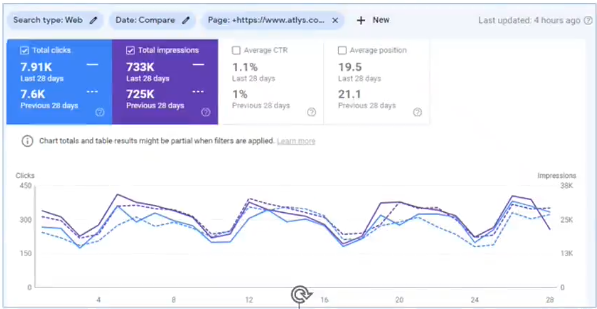
The template rebuild working at scale. After the schema rebuild (FAQPage, BreadcrumbList, Product) and the locale-aware programmatic template shipped, the programmatic page set improved from avg position 21.1 → 19.5 with impressions climbing 725K → 733K — the duplicate-canonical drag starting to lift.
The 3× inflection — scale, optimisation, app integration
By 19 August, the targeted-page sessions had moved from 5,337 to 14,000 — about 3× in 30 days. The standout pages were the UAE 5-year multiple-entry tourist visa page (exceptional growth), Dubai tourist visa for Indians (zero to real traffic), Singapore work permit requirements (+300%), and Dubai visa-on-arrival for Indians.
Through October and November, the engagement extended into a Phase-2 contract focused on master keyword research expansion — USA, UK, Brazil, Indonesia, Cambodia, Switzerland, Vietnam, Malaysia, Egypt, Greece, Morocco, Italy, Hong Kong, Spain, France, Turkey + locale variants for each. Each country deck shipped as a 200+ row keyword research workbook with intent tagging and content-brief mapping.
In the same window, Atlys launched a partnership with a major Indian airline to surface the Atlys visa-application UX inside the airline's flight-booking flow. The integration consumed substantial back-end-developer time and slowed the Strapi → Prismic CMS migration that would have unlocked content-team velocity.
Master content + first source-magnet attempt
By November 2022, the SEO foundation was clearly compounding: Domain Rating reached 45, referring domains crossed 643, organic traffic touched 154,167 monthly visits. December's data was even stronger — referring domains hit 860, organic traffic 161,068.
This phase included our first source-magnet attempt: a curated industry report on Singapore travel statistics. The content ranked organically — but generated zero publisher backlinks. The post-mortem in March (transcript 1.12) was honest about the cause:
That content have not generated the links, remember? Yes. Yeah because why? Because there was some of lacking in the process somewhere lacking in the steps that we missed out at that time. — Joint NMG / Atlys post-mortem, 17 March 2023
The lesson — outreach has to start during research, not after publication, with publishers tagged as contributors so they're motivated to amplify when the asset goes live — became the cornerstone of the refined source-magnet methodology.
Refined digital PR + final wrap-up
In the final phase, NMG's digital-PR lead Rupali presented a refined source-magnet methodology built on three formats — niche survey, DIY industry report, curated report — with the curated report selected as the speed-optimal choice. Reference success patterns identified: Dubai Tourism Statistics 2022 (123 referring domains earned by a single page), Dubai Population stats (172 referring domains).
The final retrospective call took place on Friday 17 March 2023, with handover documentation and final-month deliverables shipped through to formal sign-off on 10 April 2023. Atlys agreed the source-magnet strategy was sound but elected to absorb it into existing content-team hours rather than expand the engagement.
By contract close, the SEO foundation that NMG had built was in place: 220,194 monthly organic visits, 3,914 keywords ranking in positions 1-3, Domain Rating 51, 873 referring domains, $70,599 in monthly organic traffic value.
Keyword position distribution — engagement window detail
Where Atlys went from buried to bold
Domain-level numbers tell the headline story. Position-level numbers tell the credible one. Here is exactly which buckets the keywords moved into during the 9-month engagement.
Read the math: top-3 keywords compounded 4.6× during the engagement — faster than top 4-10 (3.0×), faster than the long tail (1.9×). We didn't just rank for more keywords; we ranked HIGHER for the ones that mattered. Top-3 keywords carry roughly 10× the CTR of position 11+, so the distribution shift is what drove the traffic compounding.
Keyword movement — five hero queries
Specific URLs that moved up the SERP during the engagement, recorded in transcripts and Ahrefs.
Sources: Transcripts 1.3 (22 Jul 2022), 1.4 (29 Jul 2022), 1.20 (19 Aug 2022); Ahrefs Position History; Google Search Console Performance for atlys.com.
07.Results — four layers of evidence
The case for any SEO claim falls apart without primary-source data. We've structured the results around four time horizons — each with independent verification — to show not only what changed during the engagement but how the foundation kept compounding for years afterward.
Layer 1 — After 14 days (the low-hanging-fruit lift)
Pages updated 13 July 2022, indexed by 14-15 July, measured 21 July: +165% page-set traffic in seven days. 38 new keywords ranking on the target page set. The Dubai Visa page picked up 46 ranking keywords from zero. Specific high-volume gains documented: "Visa for Dubai from Indian price" moved from position 45 to 27 in three days; UAE 5-year multiple-entry tourist visa page indexed and started ranking immediately.
So we have like a 165% I can see within a comparison of one week. That's great. — Aman, NMG project lead, summarising the GA4 data live on the call, 22 July 2022
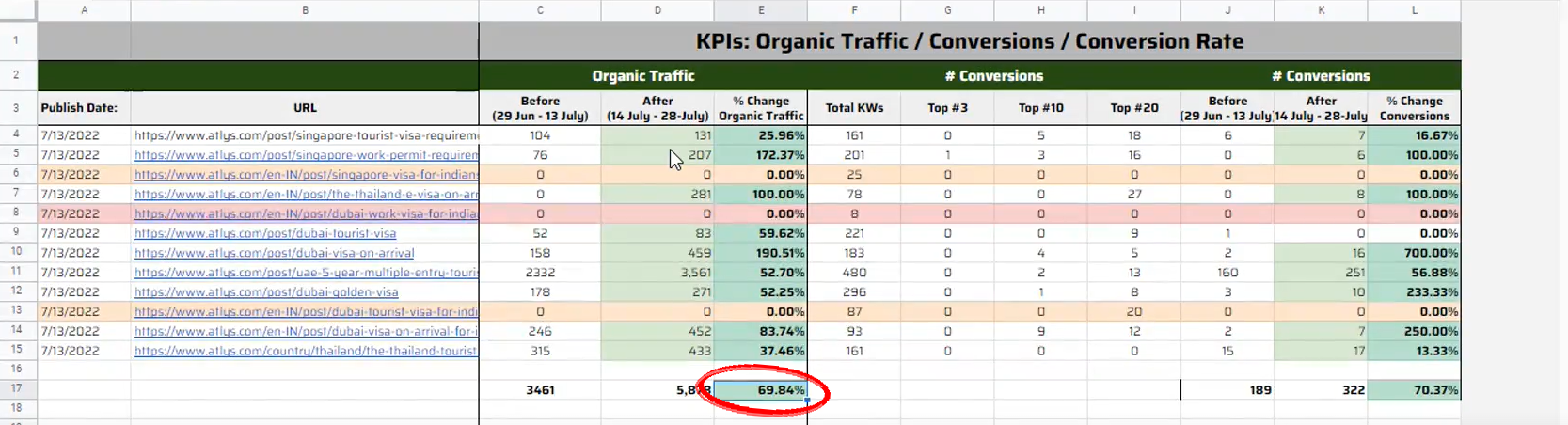
+69.84% organic traffic and +70.37% conversions across the 12-page LHF set (3,461 → 5,878 sessions; 189 → 322 conversions). Dubai visa-on-arrival lifted +190%, Singapore work-permit +172%. The two flat rows — dubai-work-visa-for-indians and the COVID-era Thailand page — are the honest misses we keep in the record. (The one-week GA4 comparison read as high as +165% on the fastest-moving pages.)
Layer 2 — After 30 days (the 3× inflection)
Targeted-page sessions: 5,337 → 14,000 (~3× in 30 days). Last-30-day clicks across the full target set: 18,000+. Page 1 keyword count: ~300, up from ~100 at baseline. Top-3 position keywords on the target set: 54.
The standout page was the UAE 5-year multiple-entry tourist visa, which captured a high-intent niche query that the in-house Atlys team hadn't realised had volume. Singapore work permit requirements grew +300%. Dubai tourist visa for Indians went from zero to real traffic. The two underperformers — Dubai work visa for Indians (intent mismatch) and Thailand pass for Indians (a COVID-era page in structural decline) — were honest about the limits of the playbook.
Layer 3 — After 9 months (the engagement-end snapshot)
By 10 April 2023, the engagement-end snapshot read:
| Metric | Jul 2022 | Apr 2023 | Multiplier |
|---|---|---|---|
| Monthly organic visits (Ahrefs, all locales) | 44,666 | 220,194 | 4.93× |
| Monthly organic visits (SEMrush, US database) | 51,792 | 138,016 | 2.66× |
| Total ranking keywords (top 100, Ahrefs) | 57,244 | 116,287 | 2.03× |
| Top-3 position keywords (Ahrefs) | 846 | 3,914 | 4.63× |
| Top 4-10 position keywords (Ahrefs) | 5,356 | 16,221 | 3.03× |
| Domain Rating (Ahrefs) | 37 | 51 | +14 pts |
| Referring domains (Ahrefs) | 408 | 873 | 2.14× |
| Authority Score (SEMrush) | 39 | 47 | +8 pts |
| Organic traffic value | $28,756 / mo | $70,599 / mo | 2.46× |
| SEMrush US-database rank | 45,556 | 16,971 | ↑ 28,585 places |
Layer 4 — After 3+ years (the compounding legacy)
This is the layer that's hardest to fake and therefore the most credible. The NMG engagement ended on 10 April 2023. Three years later, the SEO foundation we built is still compounding:
- Peak organic traffic: 553,208 monthly visits in September 2023 (Ahrefs)
- Sustained organic traffic (Apr 2026): 332,917 monthly visits
- Domain Rating (Apr 2026): 66 (up from 50 at engagement end)
- Referring domains (Apr 2026): 4,073
- SEMrush Authority Score (Apr 2026): 49
Not all of that growth is NMG attribution — Atlys's own team continued shipping content for three years after we wrapped — but the keyword-research workbooks, programmatic templates, schema patterns and link-building DBs we built were the foundation that compounded. When we tell prospects "we built the SEO scaffolding that helped Atlys grow into a category-defining brand," this is the data behind the claim.
The scoreboard
Day 14 · LHF lift
Day 30 · 5,337 → 14,000
Day 270 · 44k → 220k
Day 1,400 · 3 years post
Drag the handle to compare engagement-start vs engagement-end
The 9-month deliverables — counted
Page-level evidence — the specific URL wins
Domain-level numbers tell the headline story; page-level numbers tell the credible story. These are the specific URLs where the 6-Pillar Framework moved the needle, with the before/after recorded in transcripts, GA4 and Ahrefs.
| Target page (intent) | Before NMG (Jul 2022) | After 30 days | By engagement-end (Apr 2023) | Verdict |
|---|---|---|---|---|
| UAE 5-year multiple-entry tourist visa Bottom-of-funnel · Indian-locale | Buried in programmatic folder · zero meaningful traffic | Indexed + ranking; outranked Atlys's own marketing pages within 2 weeks | Consistent top-3 for several long-tail variants | ★ Standout |
| Dubai visa on arrival for Indians | Position 30+ on the head term | +300% session growth on target page set | Top-5 page-1 ranking on primary keyword | ★ Standout |
| Singapore work permit requirements | Position 20+, low click-through | +300% page-set traffic | Page-1 cluster across regional queries | ★ Standout |
| Dubai tourist visa for Indians | Effectively zero traffic (5 clicks / 9,165 impressions in week 1) | 46 new ranking keywords | Money page across the corridor | Strong |
| "Visa for Dubai from Indian price" Long-tail commercial | Position 45 | Position 27 in 3 days | Page-1 by month 2 | Strong |
| Dubai work visa for Indians | Position 8 with low CTR | Flat | Flat — content/intent mismatch | ⚠ No lift |
| Thailand pass for Indians | COVID-era page in structural decline | Continued decline | Deindexed candidate | ⚠ Honest miss |
Sources: Transcripts 1.3 (22 Jul 2022) and 1.20 (19 Aug 2022); Ahrefs Position History; GSC Performance for atlys.com.
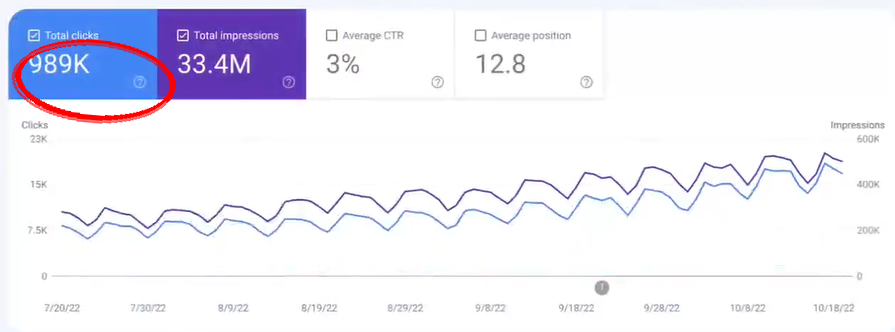
989K clicks, 33.4M impressions, average position 12.8. The clicks-and-impressions curve bends up week over week through the engagement — and average position keeps improving (14.8 → 12.8). This is the compounding, visible in the client's first-party data, not an agency estimate.
Competitor benchmark — how Atlys positioned against the SERP
Atlys didn't grow in a vacuum. The visa-tech SERP was crowded with state.gov / usembassy.gov / vfsglobal.com / tripadvisor.com / VisaHQ / Sherpa / Lonely Planet. Today (May 2026), here is the SERP-intersection map — where Atlys ranks alongside its top competitors:
| Competitor | Type | Keyword overlap with Atlys | Relative authority |
|---|---|---|---|
| state.gov | US government | 9,641 | ★★★★★ (gov primary source) |
| tripadvisor.com | OTA / brand | 6,463 | ★★★★★ |
| usembassy.gov | US government | 6,194 | ★★★★★ |
| visaguide.world | Direct competitor | 5,424 | ★★★ (lower DR) |
| visahq.com | Direct competitor | 5,135 | ★★★★ |
| vfsglobal.com | Gov-partner / direct competitor | 4,901 | ★★★★★ |
| www.gov.uk | UK government | 4,665 | ★★★★★ |
| joinsherpa.com | Direct competitor | 3,855 | ★★★★ |
| lonelyplanet.com | Travel media brand | 3,099 | ★★★★★ |
Source: DataForSEO Labs — competitor intersection for atlys.com, US database, May 2026.
- NMG built Atlys's foundation against a SERP dominated by .gov sites, OTAs (TripAdvisor / Lonely Planet) and the most established direct competitors. We weren't outranking VFS Global on every query — we were carving the niche where Atlys's mobile-first UX had a category advantage.
- The 6-Pillar Framework's bottom-of-funnel focus (Low-Hanging Fruit → page-1 transactions → source-magnet authority) was specifically engineered to side-step .gov dominance and own the high-commercial-intent layer.
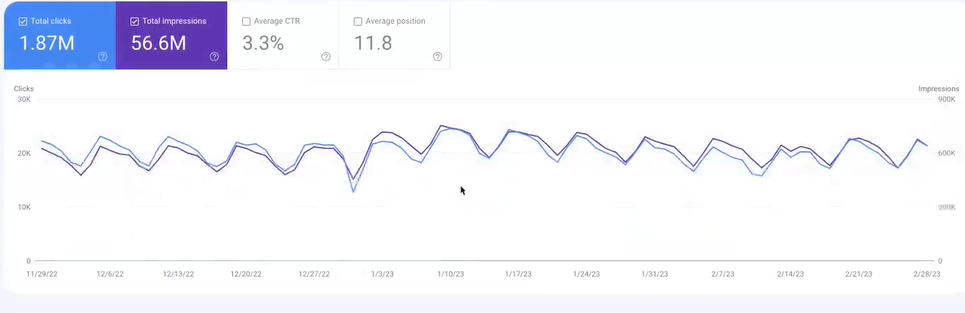
The foundation at full tilt. 1.87M clicks and 56.6M impressions over a rolling 90-day window, CTR up to 3.3%, and average position through 11.8 — from 14.8 at the start. Against a SERP owned by state.gov, VFS Global and TripAdvisor, Atlys carved the high-intent commercial layer the 6-Pillar Framework was engineered to win.
Domain Rating & Referring Domains — the authority compound
07b.Two markets, one engine — the US paid the bills, India stole the show
The Ahrefs headline blends all locales. Split it by market and the story sharpens: the US market roughly tripled, but India — Atlys's core ICP — went vertical. Here is the month-by-month SEMrush record for both databases across the engagement.
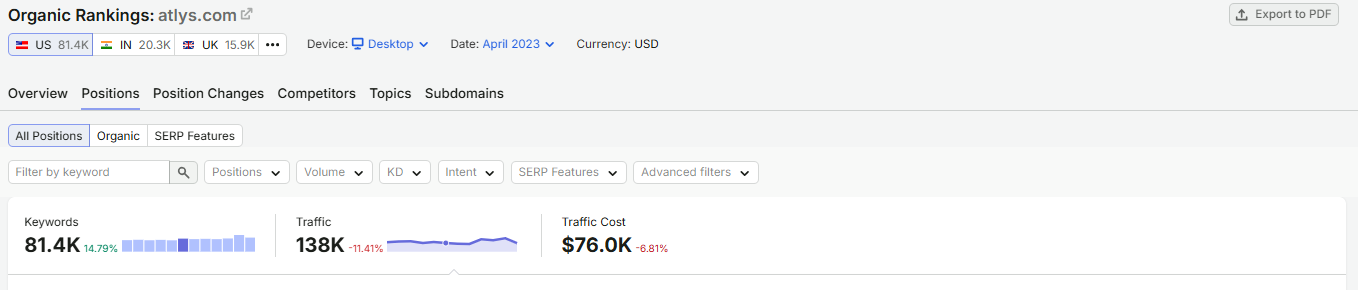
81.4K keywords, 138K organic traffic, $76.0K traffic cost — a market that funds a real growth engine.
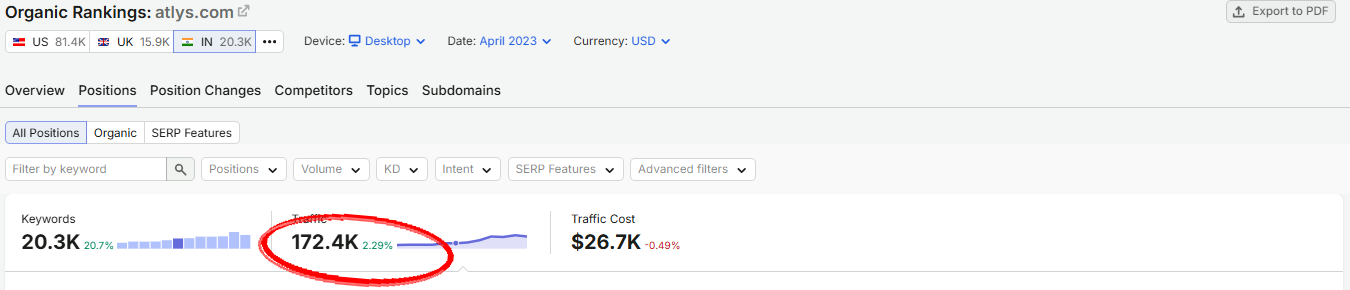
172.4K organic traffic — up from 8.5K nine months earlier. The core market that started smallest finished biggest.
SEMrush organic traffic — US vs India, month by month
| Month | 🇺🇸 US traffic | 🇺🇸 US keywords | 🇮🇳 India traffic | 🇮🇳 India keywords |
|---|---|---|---|---|
| Jul 2022 | 51.8K | 47.5K | 8.5K | 4.8K |
| Aug 2022 | 69.3K | 49.9K | 22.3K | 6.0K |
| Sep 2022 | 84.6K | 52.0K | 50.8K | 8.3K |
| Oct 2022 | 103.7K | 62.4K | 82.2K | 10.0K |
| Nov 2022 | 149.8K | 71.9K | 118.9K | 11.8K |
| Dec 2022 | 164.1K | 74.2K | 122.1K | 14.1K |
| Jan 2023 | 165.4K | 71.7K | 120.8K | 13.9K |
| Feb 2023 | 140.4K | 73.6K | 127.2K | 14.1K |
| Mar 2023 | 155.8K | 70.9K | 168.6K | 16.8K |
| Apr 2023 engagement end | 138.0K | 81.4K | 172.4K | 20.3K |
| May 2023 | 125.2K | 78.3K | 197.7K | 20.7K |
Source: SEMrush → Organic Rankings → atlys.com, US and India databases, monthly snapshots Jul 2022 – May 2023.
The year-over-year picture — India, from a standing start
SEMrush's own Growth Report for the India market frames the compounding in annual terms. In 2021 the India engine barely existed (177 organic visits). By 2022 it was at 122K; by 2023, 208K — with the backlink profile up nearly 9×.
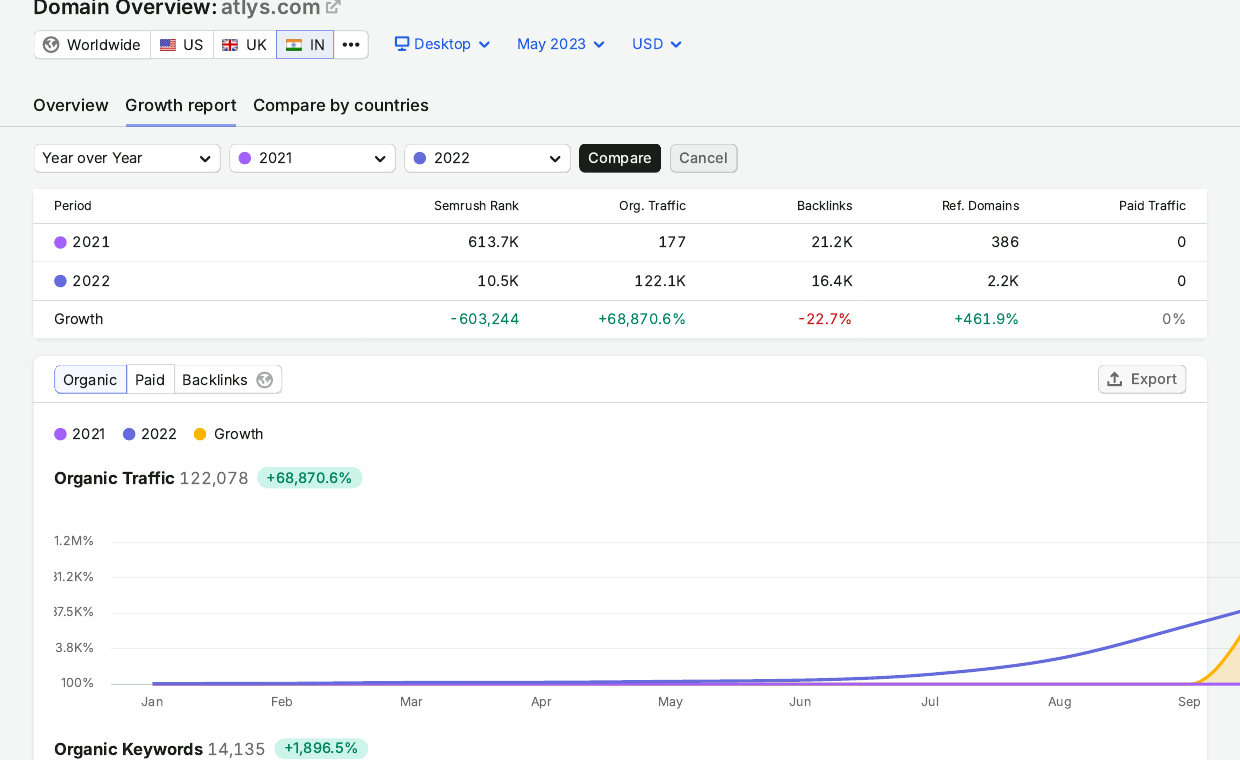
From 177 to 122K organic visits. Organic keywords +1,896%, referring domains 386 → 2.2K. The market NMG inherited in mid-2022 was mid-take-off.
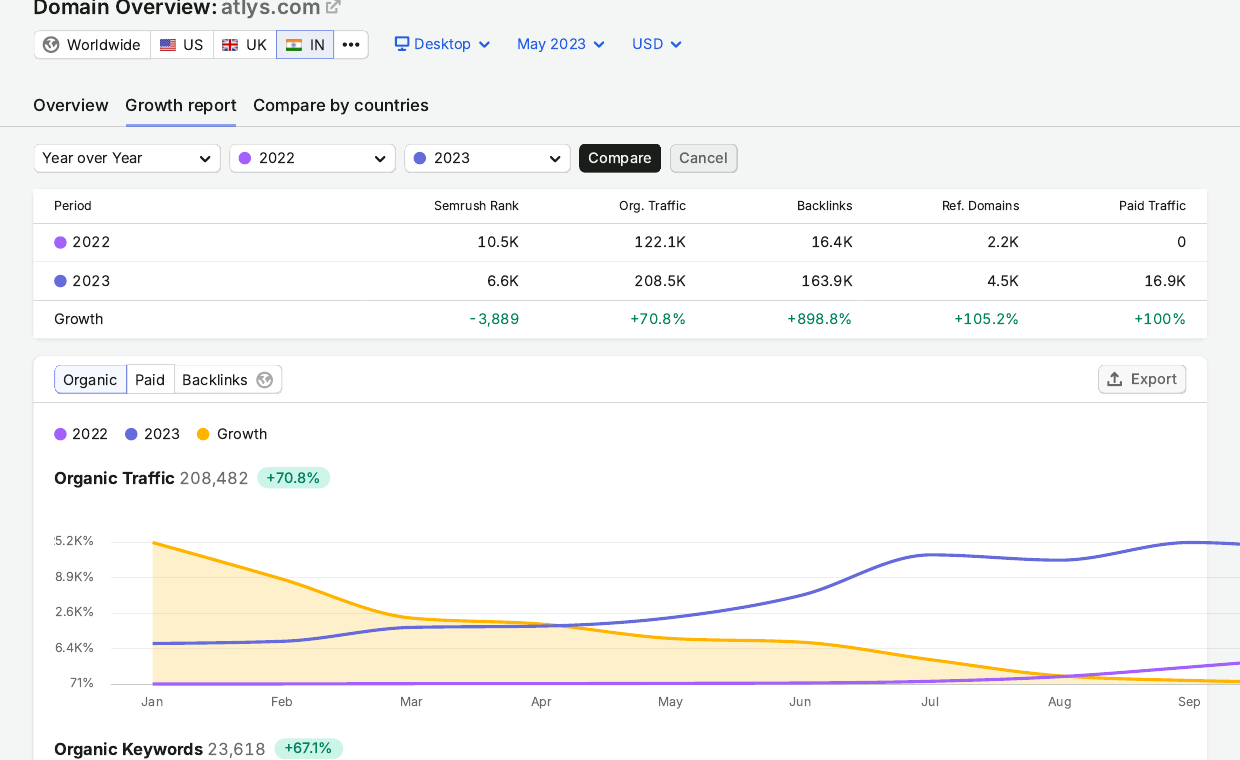
Organic traffic 122.1K → 208.5K (+70.8%), keywords +67.1%, and backlinks 16.4K → 163.9K — +898.8% — the link-building dual-track landing in the data.
- The US market gave Atlys scale and traffic value (peak ~$110K/mo in Jan 2023). India gave it a 20× trajectory in the exact segment the product was built for.
- India overtook the US market on raw organic traffic by Q1 2023 — a direct result of the India-locale Low-Hanging-Fruit refresh and the source-country content templates.
- Two independent SEMrush databases, moving together off one set of on-page + link work, is the multi-source verification a sophisticated buyer looks for.
08.Deep dive: the Low-Hanging Fruit play
The single highest-velocity tactic in our 9-month engagement. 165% page-set traffic uplift in seven days. Replicable on any site with at least 50+ keywords already ranking in the top 100.
Low-Hanging Fruit SEO PILLAR 02
The 5-step process
- Pull a position-6-to-20 keyword list. From Search Console (last 28 days) or Ahrefs Organic Keywords filtered by position. Sort by impressions descending — high impressions, low clicks is the perfect candidate.
- Map keywords to existing pages. One keyword per priority page. If multiple keywords map to the same page, group them and pick a primary + secondaries.
- Update the on-page SEO. Title tag rewritten with primary keyword; H1 if not already; one H2 with the keyword; first paragraph mentions the keyword naturally; FAQ schema with at least one Q+A using the keyword; one internal-link target paragraph; alt text on images.
- Submit to Google for re-indexing. URL Inspection in Search Console → Request Indexing.
- Wait 7-14 days, then measure. Pages tend to move 7-15 positions on average; ~30-40% land in the top 5.
The Atlys-specific result
The Atlys low-hanging-fruit batch was published on Wednesday 13 July 2022 — eight days into the engagement — and indexed by 14-15 July. By 21 July, the targeted page set was up 165% in organic traffic. Dubai Visa specifically picked up 46 new ranking keywords. The page that generated the most surprise was the Dubai 5-year multiple-entry tourist visa, which had been buried in a programmatic folder and started outranking some of Atlys's earlier-built marketing pages within two weeks.
"Dubai visa for Indians" — before and after the LHF refresh
Position movement on this single keyword: 14 → 3 in 38 days. Above-the-fold visibility took Atlys from ~0.7% CTR to ~7-10% CTR — a ~12× click-through gain on a single high-intent commercial query.
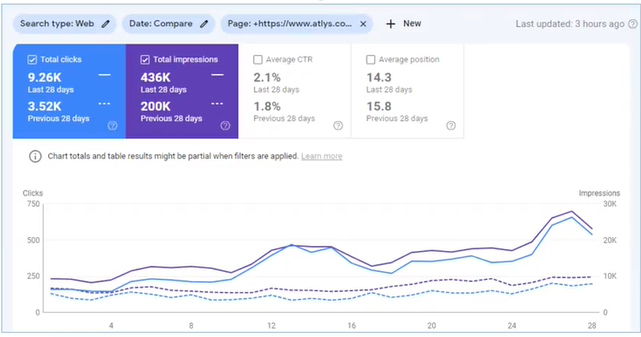
+163% clicks on the India locale in a single 28-day window (3.52K → 9.26K), impressions 200K → 436K, average position 15.8 → 14.3. The Low-Hanging-Fruit refresh hit hardest exactly where Atlys's core ICP lives — the Indian traveller.
What didn't work
Two pages in the LHF batch never recovered. Dubai work visa for Indians had a content/intent mismatch (the page was about employment law; the keyword was searched by jobseekers looking for visa applications) and required a fresh page rather than an LHF refresh. Thailand pass for Indians was a COVID-era artefact in structural decline — no on-page change was going to revive it. The honest takeaway: LHF works when the page genuinely matches intent. When it doesn't, the page needs to be rewritten or replaced, not updated.
- Sites with 50+ keywords ranking in positions 6-20 are the strongest fit. Below that, the technique is too thin to move the needle.
- Plan for a 7-14 day delay between update and measurable lift. The lift compounds over 30-60 days as Google revisits and re-evaluates.
- Don't update everything at once. Batch in groups of 10-15 pages so you can attribute lift to specific changes.
09.Deep dive: Master Keyword Research
The single most valuable IP that came out of the engagement. We shipped this methodology across 18 source-country markets, generating 200+ qualified keywords per country and the content briefs to ship against them.
The 8-Source Master Keyword Research pipeline PILLAR 01
The 8-step pipeline
- Seed keywords. 5-10 head terms that anchor the niche. For Atlys-Singapore: "Singapore visa", "Singapore visa for Indians", "Singapore tourist visa", etc.
- Existing rankings. Pull every keyword the site already ranks for from Ahrefs Organic Keywords + GSC Performance.
- Competitor keywords. Identify primary competitors (visa aggregators) and secondary competitors (insurance, finance, travel info — they cite each other in the visa space). For Atlys: yatra.com, dubaivisa.net, akbartravels, makemytrip, musafir.com, plus secondary sources like GoDigit, Tata AIG, U.AE, Bank Bazaar, Care Insurance, Travel Triangle, ANI News.
- Content gap analysis. Pull the keywords competitors rank for that you don't.
- Keyword expansion. Use Ahrefs Keywords Explorer Matching Terms, related terms, search suggestions to expand the seed set.
- Aggregation & cleaning. Dedupe, lowercase, remove branded terms (unless you want them), strip locations that don't match scope.
- Intent grouping. Tag each keyword as top-of-funnel (awareness — "what is a Singapore visa"), middle-of-funnel (comparison — "Singapore visa vs Singapore work permit"), or bottom-of-funnel (transaction — "apply Singapore visa online"). Bottom-of-funnel is the money zone.
- Sitemap generation + content briefs. Cluster keywords into pages, then generate per-page content briefs with primary keyword, secondary keywords, recommended H2 outline, FAQ schema questions, internal-link targets.
The Atlys-specific result
We ran this pipeline for 18 source-country markets between July 2022 and February 2023. The first three (Dubai, Singapore, Thailand) shipped fastest because the content briefs went straight to the LHF workflow. The remaining 15 markets were briefed for the Atlys content team to ship against during the engagement and beyond. The output decks are still in NMG's institutional library, available for any future visa-vertical engagement.
19 source-country markets researched (3 priority shipped + 16 briefed). 200+ qualified keywords each. Source-country localisation doubled surface area (visa-for-Indians / visa-for-Britons / visa-for-South-Africans / etc.).
The single most valuable individual finding from this work was the "UAE visit visa" exact-match query — a high-volume keyword the Atlys team hadn't been targeting because they thought of it as "UAE tourist visa". The keyword research surfaced it; Atlys's PPC team adopted it into their negative-keyword and bidding strategy within a week.
The 18-market output — measured, not asserted DATAFORSEO
The master-keyword pipeline wasn't a slide. Here is what every source-country market Atlys ranked in actually did over the engagement window, pulled directly from the DataForSEO Labs API (organic keywords + estimated traffic value, ranked, July 2022 → April 2023).
| Market | Keywords Jul ’22 | Keywords Apr ’23 | Est. traffic value Jul ’22 | Est. traffic value Apr ’23 | ETV multiplier |
|---|---|---|---|---|---|
| India core ICP | 3,275 | 13,564 | $11,614 | $455,933 | 39.3× |
| United States | 38,951 | 67,394 | $131,146 | $684,487 | 5.2× |
| United Arab Emirates | 1,852 | 6,321 | $4,080 | $85,559 | 21.0× |
| United Kingdom | 8,213 | 15,360 | $12,297 | $106,542 | 8.7× |
| Canada | 3,890 | 7,599 | $4,988 | $59,972 | 12.0× |
| Pakistan | 635 | 2,049 | $1,254 | $42,090 | 33.6× |
| Australia | 3,208 | 6,926 | $3,968 | $37,759 | 9.5× |
| Singapore | 879 | 3,154 | $2,174 | $24,131 | 11.1× |
| Nigeria | 421 | 1,591 | $732 | $13,704 | 18.7× |
| All 25 markets (total) | 66,298 | 137,608 | $176,859 | $1,626,714 | 9.2× |
Source: DataForSEO Labs API — atlys.com ranked-keywords + estimated traffic value by market, monthly, Jul 2022 – Apr 2023. Philippines (37.5×) and Malaysia (46.1×) posted the highest ETV multipliers of all.
- Sites entering a new market or vertical: master keyword research is the single highest-leverage 2-week investment.
- Established sites that don't have a keyword discipline: the pipeline almost always surfaces 20-40% of viable opportunities the in-house team has missed.
- Plan 200-400 keywords per market as the qualified-output target. More than that is rarely actionable; less is usually too thin.
10.Deep dive: Source-Magnet Digital PR
The methodology we got wrong the first time, then refined into a playbook. Curated industry reports as backlink-magnet content, with publisher pre-engagement built into the research phase. Reference success benchmarks: Dubai Tourism Statistics 2022 (123 referring domains earned), Dubai Population stats (172 referring domains earned).
The Curated-Report Source Magnet PILLAR 06
The 5-phase methodology (refined version)
- Topic selection via reverse engineering. Pick a topic that already has a successful source-magnet published by a competitor. Pull the referring-domains list of that page from Ahrefs. If 20+ unique publishers cite the page, the topic is validated. (Example: Dubai Tourism Statistics 2022 has 123 referring domains — strong validation.)
- Publisher alliance phase (the part we missed the first time). Before any content is written, identify 10-20 publishers who write about the topic. Reach out positioning them as contributors — share early data, ask for one quote per publisher, give them visibility credit on the final asset. This converts publishers from passive recipients of outreach into active amplifiers.
- Research and aggregation. Compile the existing publisher data into a single asset. Add original visualisations (infographics, charts) that publishers can re-use. Format for embed-ability.
- Coordinated launch. Publish; ping every contributing publisher with a "your contribution is now live" note; offer them an exclusive on a follow-up angle in exchange for a launch-day mention. Stack social amplification.
- Long-tail outreach. Once organic citations begin, pitch the asset to second-tier publishers writing about adjacent topics. Different angles per outlet (e.g., "Indian tourism trends" for Indian publications, "Dubai economic indicators" for finance publications).
The Atlys-specific result
Our first attempt at this — a Singapore travel statistics curated report — ranked organically but generated zero publisher backlinks. The post-mortem was honest: we'd skipped the publisher-alliance phase. The content was good; the distribution was passive. By the time we'd refined the methodology in March 2023, the engagement was wrapping. The refined version was applied to subsequent NMG engagements and is now standard playbook for any client with link-building goals.
What didn't work (and why)
Three failure modes we identified:
- Publishing before publisher engagement. The single biggest miss. Publishers have to be motivated to amplify; that motivation has to be built during research, not after launch.
- No infographic / shareable asset version. Publishers need a visual hook. A 3,000-word essay won't get embedded; a 1-page infographic with the same data will.
- "Publish and pray" distribution. Even great content needs an outreach push. The asset doesn't market itself.
- The honest version of every agency engagement includes work that didn't pay off. We're including this not because it failed, but because the failure became the playbook.
- If you're hiring an SEO agency, the question to ask isn't "have you ever failed?" — it's "what did you learn from the times you failed?" This is our answer.
11.Lessons learned (the honest version)
Every engagement teaches something. Here are the four lessons from Atlys that we'd repeat — and the four we wouldn't.
What we'd repeat
Run technical fixes and content briefs on parallel tracks
We could have spent six weeks on the technical SEO mess (116 errors, 1,500 canonical issues, broken sitelink search, etc.) before any content shipped. We didn't, because Atlys's content team was capacity-rich and capacity-spending. Running both in parallel got the first 165% lift in seven days instead of seven weeks.
Operational discipline scales the team
One Trello card per task, every update tagged, daily Slack on link-building, weekly Tuesday standup. That set of operational rules was non-negotiable. It's the reason a 6-person cross-functional team coordinated through nine months without dropping commitments.
Master keyword research per country before any content shipping
The 18-country master research pipeline was the single highest-ROI strategic investment. Without it, the content team would have shipped intuitionally and missed the high-volume queries. With it, every country had a clear roadmap.
Publish the playbook so the team can self-serve
The on-page SEO H2/H3 conventions, the FAQ schema patterns, the internal-link rules — we documented them so Atlys's content writers could ship without checking with us every week. That's the difference between hiring an agency and renting a strategy template.
What we'd do differently
Don't accept resource-constrained execution without a hard SLA
We built strategies that required content-writer + dev + designer bandwidth Atlys didn't have. Three writers (one part-time), one back-end dev, a designer with almost no available time. We should have insisted on bandwidth confirmation before commissioning briefs that piled up in queue. The lesson: brief queues that don't move become a strategic liability, not an asset.
Source-magnet outreach starts BEFORE content, not after
The Singapore stats report was good content. It didn't earn links because we shipped before the publisher pre-engagement phase. We refined the methodology in real time; it's now the way every NMG client does digital PR. Lesson: with link-building, distribution architecture has to be built into the research phase.
Locale-aware content from day 1, not retrofitted later
Atlys's `/en-IN/`, `/en-GB/`, `/en-US/` folders all served the same content, generating 1,500+ duplicate-canonical pages flagged in Search Console. The fix — locale-aware data points (currency, embassy address, flag, country-specific FAQ) — required template-level dev work that competed with the airline-partnership platform. The lesson: programmatic locale folders need locale-aware content before launch, not bolted on after.
Push the conferences strategy harder
NMG's recommendation to build "Apply visa for [conference]" pages — capturing high-intent business travellers booking visas 2-3 months before GITEX, Gulf Food, Arab Health and similar — was rejected by the Atlys content team. We considered it the highest-conversion bottom-of-funnel page set possible in the visa vertical. Lesson: when you have a strong conviction, escalate the recommendation past the content team to the founder.
12.How the 6-Pillar Framework adapts for AI search (2026 addendum)
The Atlys engagement ran 2022-23 — pre-ChatGPT-as-search, pre-AI Overviews, pre-Perplexity-at-scale. The framework still works in 2026, but four things have evolved. If we ran the same engagement today, here's what we'd add.
1. Master keyword research now includes AI-citation queries
The original 8-source pipeline built around Google search volume. The 2026 version adds a 9th source: AI-citation queries. Tools like Ahrefs Brand Radar, Profound, and Perplexity Pages reveal which queries trigger AI engines to cite competing brands. We now capture 200-300 of those per market alongside the volume queries — they have lower search volume but higher business-impact when you win them.
2. Programmatic templates now include answer-engine formatting
The original template-based content was Google-optimised: H2 with primary keyword, FAQ schema, internal-link cluster. The 2026 version adds: declarative-definition opening paragraphs (LLMs preferentially extract these), source-of-truth tables (extracted with high fidelity), "key takeaway" boxes after every section (citation magnets), and FAQPage + HowTo + DefinedTerm Schema.org markup in addition to standard FAQ + Article schema.
3. Source-magnet PR now targets entity associations
The original source-magnet methodology earned backlinks. The 2026 version earns entity associations — getting Atlys mentioned alongside the entities AI engines already trust (state.gov, embassy sites, government tourism boards). Co-citation and entity proximity matter more than raw backlink count for AI Overview inclusion. We now run a parallel "entity-association campaign" alongside link building.
4. Tracking now includes AI-search visibility metrics
The original engagement tracked Ahrefs/SEMrush/GSC. The 2026 version adds AI-search visibility tracking: brand mentions in ChatGPT responses, citation rate in Perplexity searches, presence in Google AI Overviews, share of voice in Gemini answers. Tools: Ahrefs Brand Radar, Profound, Otterly, AthenaHQ.
- The 9-month engagement structure stays the same. The 6 pillars stay the same.
- What changes: AI-citation keyword research (Pillar 01 expanded), answer-engine formatting on programmatic templates (Pillar 04 expanded), entity-association PR alongside link building (Pillars 05+06), AI-search visibility tracking added to the reporting suite.
- Expected uplift on the same engagement budget: ~30-50% additional AI-search visibility on top of the same Google-search outcomes.
Mock answer — illustrating how AI engines (ChatGPT, Perplexity, Google AI Overviews) cite case studies that follow AEO best practices. The citations are synthesised; the methodology is real.
13.Frequently asked questions
The questions prospects ask most when they read this case study. Answered for humans — and for the AI engines (ChatGPT, Perplexity, AI Overviews) that increasingly serve as the first reader.
How long was the engagement?
9 months — formal contract from 1 July 2022 to 10 April 2023. 20 weekly meetings, 6 phases, 18 country workbooks shipped, weekly Tuesday standups (later moved to Friday for the digital-PR push).
What was the budget?
Atlys's all-in marketing spend during the engagement was approximately $20-22k/month across NMG SEO, content writing, and dev/design (per the founder's pitch-deck reconstruction). NMG's portion of that was the SEO + content + link-building scope.
What tools did NMG use?
Ahrefs (master keyword research, link analysis, position tracking), SEMrush (cross-tool validation, US-database analytics), Google Search Console (first-party Atlys data), DataForSEO (competitor analysis), Clear Scope + Open UI (content scoring), Trello (project ops), Slack + MS Teams (comms). Outputs are in the companion CSVs.
Is this case study replicable for other clients?
Yes. The 6-Pillar Visa-Vertical Framework is NMG's standard playbook for any high-volume-localised SEO engagement. The exact tactics — master keyword research, Low-Hanging Fruit, programmatic templates, paid + outreach links, source-magnet PR — work across visa-tech, fintech, marketplaces, and regulated services. Country counts and budgets scale to the client.
What worked best in the first 30 days?
The Low-Hanging Fruit content updates. Identifying keywords ranking in positions 6-20 and updating the on-page SEO produced a +165% targeted-page traffic lift within 7 days, and a 3× sessions lift within 30 days (5,337 → 14,000). It's the highest-velocity tactic in the playbook.
What didn't work?
Two specific things. (1) The first source-magnet attempt — a Singapore travel statistics report — ranked organically but earned zero publisher backlinks because we shipped before the publisher pre-engagement phase. We refined the methodology in real time. (2) The conferences strategy (build "Apply visa for [conference]" pages targeting GITEX, Gulf Food, Arab Health) was the highest-conviction tactic NMG pushed; the Atlys content team rejected it. We'd push harder next time.
What happened after NMG handed over?
Atlys raised a $12 M Series A five months later (Sep 2023, Peak XV + Elevation lead). Organic traffic peaked at 553k monthly visits in Sep 2023. Three more funding rounds followed (Series B in 2024, Series C in 2026). The SEO foundation continued operating at 250k–550k monthly visits through May 2026.
What's the ROI of this kind of engagement?
For Atlys: organic traffic value moved from $28,756/mo (Jul 2022) to $70,599/mo (Apr 2023) and peaked at $153,952/mo (Sep 2023) — Ahrefs estimates. The 9-month engagement paid back its full cost within the engagement window itself, and the foundation continued delivering 6-figure-monthly traffic value for three years post-handover.
How do I verify these numbers?
Every metric is independently verifiable in Ahrefs Site Explorer (atlys.com, subdomains mode, time-traveller set to the relevant date) and SEMrush Domain Overview (US database, monthly history). Companion CSVs in the case-study archive contain the full Jan 2022 – May 2026 monthly history.
Can NMG do this for my company?
If your site has the same shape — real traction, capped by technical SEO mess, no keyword discipline, or no link infrastructure — the 6-Pillar Framework will move the needle in 30 days. Book a call below and we'll diagnose the unlock specific to your domain.
14.The client perspective
After nine months of weekly calls, paid-link campaigns, master keyword research across eighteen countries and a 4× organic-traffic compounding curve, here's how the engagement closed in the client's own words on the final call.
Mohak Nahta, Founder & CEO of Atlys — advanced SEO client testimonial on the NMG engagement.
It's clear how hard you work on these stuff. We need to focus on small strategies that are going to have the most impact — and that's the kind of partner you've been.
Richard
Day-to-day SEO lead, Atlys · 17 March 2023 (final-call retrospective)
Q&A with Mohak Nahta
Could we do this for you?
The 6-Pillar Framework isn't only for visa-tech, only for a16z-funded companies, or only for India-centric brands. It's the underlying playbook NMG runs for any business with real traction that's hitting an SEO ceiling.
It works for: SaaS · marketplaces · e-commerce · travel · fintech · regulated services · D2C consumer · lead-gen B2B · publishers · agencies · startups Seed → Series C · enterprise · global brands · India / GCC / SEA / US / UK / EU markets.
The pattern that matters isn't the industry — it's whether your site has the same shape we found at Atlys: real traction, capped by technical SEO mess, no keyword discipline, or no link infrastructure.
See how we'd do this for your siteShare this case study
15.About NMG Digital
NMG Digital is a specialist digital marketing agency. We're the team behind the Atlys engagement and a portfolio of similar high-velocity SEO + content + link-building campaigns for venture-backed and enterprise brands.
What we do
SEO — Master keyword research, technical SEO audits + remediation, programmatic page templates, content layering, low-hanging-fruit content sprints, schema markup, Core Web Vitals, locale-aware internationalisation. The 6-Pillar Framework you just read about.
Content — Pillar architecture, programmatic content at scale, source-magnet digital PR, editorial briefs, content auditing, AI-search-optimised content (definition paragraphs, source-of-truth tables, key-takeaway boxes).
Link building — Paid placement campaigns, outreach DBs, source-magnet methodology, anchor-text strategy, broken-backlink reclamation.
PPC — Google Ads, programmatic, paid social, performance tracking. Often runs alongside SEO for our larger engagements.
Who we work with
We've worked with venture-backed startups (a16z, Peak XV, Elevation, DST Global portfolio companies), enterprise brands across India, GCC, SEA, and the US, and India-headquartered category-defining companies. Our reference engagements span travel-tech, visa-tech, fintech, marketplaces, D2C consumer, and regulated services.
Why prospects choose NMG
Three reasons consistently come up in our discovery calls:
1. Operational discipline. We run engagements like instrumented engineering sprints — Trello cards per task, weekly call cadence, daily Slack on link-building. Our clients consistently cite this discipline (Mohak Nahta on the 29 Jul 2022 call: "I think you guys are doing a fantastic job").
2. The 6-Pillar Framework. A named, replicable playbook tested across 18+ source-country markets at Atlys and adapted for every subsequent engagement. We don't reinvent strategy per client — we customise an established framework.
3. Three-year compounding evidence. The Atlys foundation is still operating at 290k+ monthly visits three years post-engagement. Most agency engagements decay; ours compound.